%20(3)%20(2).jpg)


SEIS and EIS are often talked about as a single package - “EIS/SEIS” - but they're two distinct schemes, aimed at different stages of a company's life, with different reliefs and different qualifying rules.
For investors, understanding which scheme a company is raising under (and why) says something meaningful about the stage of risk being taken on. This article sets out how the two compare, and why a company might use one, the other, or both in sequence.
The core difference: stage, not sector
The SEIS is designed for the earliest, riskiest stage of a company's life - often pre-revenue, sometimes pre-product. On the other hand, the EIS supports companies a stage further on: still early and still high-risk, but larger, more established, and typically post-SEIS raises. The distinction isn't about industry or ambition; it's about how much risk the company represents at the point of investment, which is why the qualifying tests are built around size, age, and prior funding rather than sector.
Company-side qualifying conditions, compared
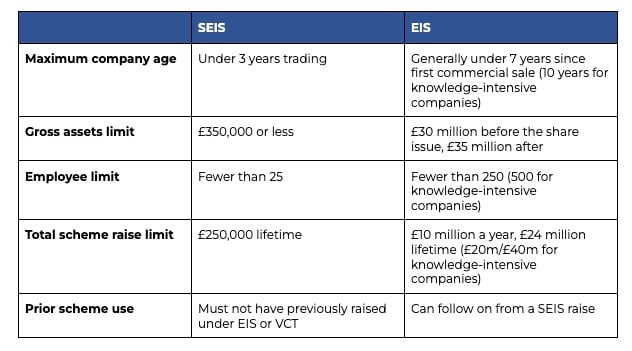
Figures reflect current HMRC guidance following the Finance Act 2026 changes to EIS limits, which took effect 6 April 2026. SEIS limits were last revised in April 2023 and were not changed in this package.
Comparing investor-side reliefs
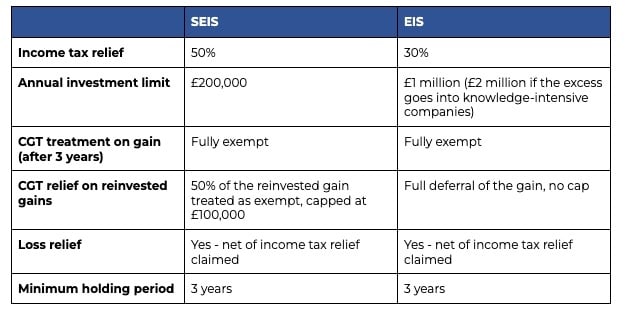
The higher SEIS relief rate reflects the higher risk: SEIS companies fail at a higher rate than EIS companies, and the tax system is designed to compensate accordingly.
Why a company might use both, in sequence
A common pattern: a company raises its first round under SEIS while it's small enough to qualify, then moves to EIS for a later, larger round once it's grown past SEIS's size and age limits. This works because using SEIS doesn't disqualify a company from EIS later - the reverse isn't true, though: a company that has already raised under EIS (or VCT) cannot subsequently raise under SEIS.
For investors, this sequencing matters. An investor who backed a company's SEIS round and then also participates in its EIS round is investing in the same company at two different risk stages, with two different relief structures - worth tracking separately for both compliance purposes (SEIS3 and EIS3 certificates are issued independently) and portfolio planning.
What this means for portfolio construction
Because SEIS carries the highest relief and the highest risk of the two, some investors treat it as the smaller, higher-conviction allocation within a broader early-stage portfolio, with EIS forming the larger allocation across more established (though still high-risk) companies.
No rule says this is the “right” approach however, it depends on an individual investor's risk appetite, tax position, and diversification goals - but understanding the distinction between the schemes is a useful starting point for that conversation.
This article is for general information only and does not constitute financial, tax, or legal advice. Tax treatment depends on individual circumstances and current legislation, both of which can change. Figures are correct as at the date of publication and should be independently verified via GOV.UK, or with a qualified adviser, before being relied upon.