%20(3)%20(2).jpg)


At a glance:
- The cut to VCT income tax relief from 30% to 20% risks reducing investor appetite and contradicts the Government’s ambition to build a high-growth environment.
- Expanded fundraising limits for early-stage companies offer structural improvements, but may be ineffective if VCTs struggle to raise more capital under weaker incentives.
- EIS and SEIS become comparatively more attractive, potentially drawing increased investment activity as capital rebalances across the tax-efficient landscape.
- Investor behaviour may split: more experienced investors shift toward EIS/SEIS, while others step back from early-stage risk altogether.
- The long-term concern is diminishing incentives could slow innovation funding, despite the Government’s intention to strengthen the UK’s scale-up ecosystem.
A Confusing Signal for a “Startup Britain”
The Chancellor’s decision to reduce upfront income tax relief on Venture Capital Trust (VCT) investments from 30% to 20% has triggered understandable concern across large parts of the early-stage investment community. For a government that has repeatedly positioned itself as pro-innovation and committed to a “startup Britain”, the move sends a confusing signal to both investors and founders - especially when standing isolated from any other pro-growth policy.
The Treasury argues that the reduction simply brings VCTs and EIS into closer alignment, creating a more balanced incentive structure and ensuring capital flows to the highest-growth companies. Whilst this may balance the incentives between schemes, this could have been handled differently - as we speak on later.
In practice, the cut clearly weakens one of the core incentives that has long drawn investors into higher-risk, illiquid early-stage businesses. Those who have already maximised ISAs and pensions have relied on VCTs, EIS and SEIS not just for growth exposure, but for capital gains advantages, IHT benefits, and diversification into private markets. Reducing the headline VCT relief fundamentally shifts the risk-return calculation - and not in a direction that drives more capital into innovation.
History directly reinforces this concern. When VCT tax relief was cut from 40% to 30% in 2006, its fundraising collapsed by around two-thirds and took more than a decade to recover.
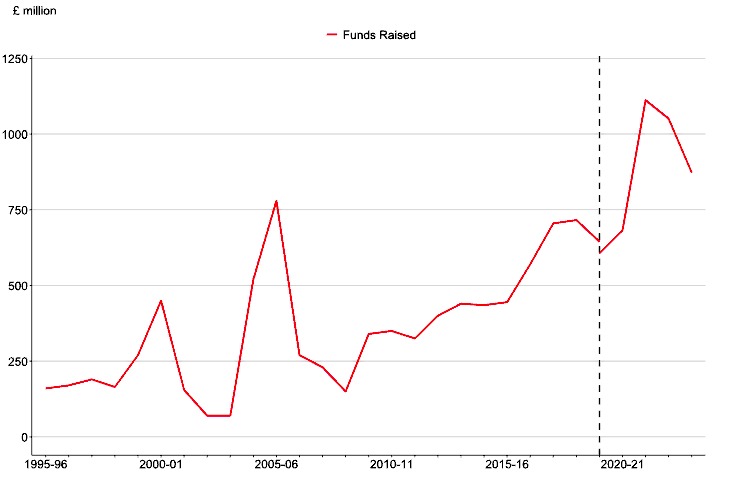
Source: ons
That experience sits rather awkwardly alongside the Treasury’s expectation that the new reduction is expected to raise a relatively small £65m in 2027/28 less than 0.005% of total government spending (equivalent of someone on an average salary finding £1.80 in their pocket), falling to £45m by 2029/30, and HMRC’s own acknowledgement that the policy is "not expected to have any significant macroeconomic impacts."
Venture Capital Scheme Investment Limit Changes
Alongside the cut, the Budget significantly expands how much early-stage companies can raise.
Lifetime limits will double to £24m for non-knowledge-intensive businesses and £40m for knowledge-intensive firms. On paper, this broadens the runway for fast-growth companies. In reality, it risks becoming a hollow victory: widening what VCTs can invest is of limited use if those same funds are simultaneously getting less attractive.
Pension contributions continue to offer up to 45% tax relief, without the liquidity constraints of VCTs. It is therefore logical that some investors will likely reweight portfolios toward lower-risk products - a shift that directly contradicts the government’s broader objective of channelling more capital into innovation and scale-ups. Industry reaction reflects this contradiction, with several commentators describing the move as “the sting in the tail”, “an appalling blow”, and even “a stupid change”.
A Missed Opportunity to Strengthen, Not Weaken, Incentives
Considering the potential short-term economic gains previously mentioned, a more effective approach may have been to balance VCT and EIS incentives by raising, rather than reducing, reliefs - if a rebalance was required at all.
Increasing upfront income EIS/SEIS tax reliefs by 5% and 10% - or a more measured 2.5% and 5% - would almost certainly have improved sentiment, supported fundraising, and also generated positive visibility for the entire venture capital ecosystem. The immediate short-term fiscal impact would, admittedly, be a modest reduction in tax receipts, but the longer-term returns - innovation, high-skill job creation, and economic expansion - could outweigh any initial reduction in tax receipts.
After all, as a widely accepted economic principle, true growth policy looks beyond quick revenue wins and focuses on long-term impact.
The EIS and SEIS are now in the Spotlight
Crucially, the EIS and SEIS schemes remain untouched by the reforms - this alone may shift the direction of private capital over the coming years. Whenever one part of the tax-advantaged landscape becomes less attractive, capital naturally redistributes. With VCT incentives weakened, EIS and SEIS now stand out more sharply, offering higher reliefs, stronger downside protection, and a direct link to early-stage growth.
As a result, it would not be surprising to see an uptick in EIS and SEIS activity this tax year. For investors who previously favoured VCTs for their lower-risk profile and tax-free dividends, the recalibration may prompt a shift toward exploring EIS/SEIS, or for some, a retreat from early-stage investing altogether as they instead consider other high-return investments.
What Happens Next?
The policy outcome is likely to be twofold. On one side of things, EIS and SEIS become even more central to the UK’s high-growth pipeline, strengthened by their relative stability during a period of policy disruption. On the other hand, the broader ecosystem may contract if certain investors reduce activity altogether in response to lower VCT incentives.
Either way, the next few years will reveal whether this recalibration strengthens Britain’s innovation and economic position or constrains one of its most important funding channels.




.jpg?width=1920&height=1280&name=shutterstock_1065744152-min%20(1).jpg)