%20(3)%20(2).jpg)


This week’s briefing focuses on the trends shaping the UK economy in the run-up to November’s Budget. We examine the rise in household savings and what it signals for businesses and consumer demand, the resilience of the housing market as wages and employment continue to support activity, London’s sharp fall in global IPO rankings, and the latest revisions to GDP data that paint a mixed picture of growth momentum.
Read on for the full breakdown.
Households Save More as Growth Slows
UK households continued the trend in building up savings in the second quarter of 2025, a clear sign of ongoing caution despite rising wages and tax reductions. The ONS reported that the savings ratio rose to 10.7 per cent, well above the pre-pandemic average of 5.6 per cent for example. This uptick in savings came even as disposable income increased, suggesting that many households are still holding back from spending.
The caution from households is being felt across the retail sector. Companies from John Lewis to JD Sports have raised concerns about subdued confidence and “strained” finances. Online fast-fashion retailer Asos recently downgraded its annual revenue expectations, and even high street leader Next warned that sales growth is likely to slow in the months ahead. These issues are being felt equally by small businesses, selling non-essentials.
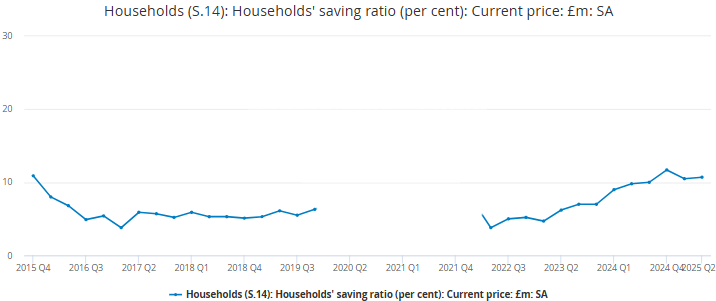
This backdrop comes ahead of a crucial autumn Budget, where Chancellor Rachel Reeves has, again, signalled “tough choices” and likely tax rises. Analysts warn that sentiment could quickly sour if households anticipate heavier fiscal burdens. As Martin Beck of WPI Strategy noted, consumer confidence could flip a “potentially virtuous cycle into a vicious one” if November’s Budget undermines spending appetite.
Housing Market Resilient Despite Tax Clouds
In contrast to the subdued tone in household spending, the UK housing market has shown surprising resilience. Nationwide reported that house prices rose 0.5 per cent between August and September, pushing the average property value to £271,995. On an annual basis, prices climbed 2.2 per cent, outpacing forecasts of just 1.8 per cent.
This growth came despite widespread expectations that looming tax rises in November’s Budget would dampen property sentiment. Instead, the market has been supported by low unemployment, which remains historically low at 4.7 per cent, and rising wages, which were up 4.8 per cent in the three months to July. Stronger household balance sheets and optimism that the Bank of England could cut rates next year have also helped keep demand intact.
However, the gains were uneven. Semi-detached homes led the way with prices rising 3.4 per cent over the past quarter, while detached properties gained 2.5 per cent and flats saw a slight decline of 0.3 per cent. Regionally, Northern Ireland stood out with price growth of 9.6 per cent, while London barely moved, recording just 0.6 per cent growth.
Mortgage approvals have stabilised at pre-pandemic levels, and quoted mortgage rates have begun to edge lower, giving further support to the market. Even so, the Budget looms as a key test. Economists suggest that if new taxes are carefully structured, the property sector could avoid a sudden downturn.
As Robert Gardner, Nationwide’s chief economist, put it: “Despite ongoing uncertainties in the global economy, underlying conditions for potential homebuyers in the UK remain supportive. Providing the broader economic recovery is maintained, housing market activity is likely to strengthen gradually in the quarters ahead.”
Growth Revisions Show Mixed Picture
Alongside the fresh headline data, the ONS has also revised its GDP estimates for 2024, revealing a slightly stronger performance in the latter part of the year than first reported. While GDP growth for the year as a whole remains unchanged at 1.1 per cent, quarterly figures were adjusted, with weaker expansion early in 2024 offset by modest upward revisions later on. Notably, the third quarter moved from flat to 0.2 per cent growth, while the fourth quarter was revised to 0.2 per cent.
Output across key industries showed imbalances. Services, which make up the largest share of the economy, grew by 0.4%, but production fell by 0.8%, worse than initially reported, while construction growth was revised down slightly to just 1%. This uneven performance reflects the same consumer caution seen earlier, where disposable income gains are not yet translating into broader demand.
Economists expect the second half of 2025 to remain challenging. Rising inflation, slower wage growth, and near-inevitable tax rises in the autumn Budget all point towards sluggish expansion. With interest rate cuts now seen as less likely next year, the economy could face tighter conditions than previously hoped.
Thomas Pugh of RSM UK captured the uncertainty well: “The increase in the saving ratio suggests consumers turned more cautious in the second quarter. The big question now is whether speculation about the Budget will undermine confidence further.”
Matt Swannell of the EY Item Club summarised the risks neatly: “The detailed GDP data pointed to more weakness than the headline reading suggested, as consumer caution continued to hold back private demand. The UK looks set for sluggish growth over the coming quarters as real incomes are squeezed and further tax rises in the autumn Budget look almost inevitable.”
London Loses Ground in Global IPO Rankings
Away from households and housing, London’s financial standing has taken another hit, with the city dropping out of the world’s top 20 IPO markets. According to Bloomberg, London has slipped to 23rd place, overtaken by Singapore and Mexico, with Oman even ranking ahead. IPO volumes this year collapsed by 69 per cent to just US$248 million - the weakest figure in more than 35 years.
This is a stark contrast to the rise of other markets. Singapore, powered by property trust listings, raised US$1.44 billion and now sits ninth globally. Mexico saw US$460 million in deals, almost double London’s total, despite having little activity just a year earlier.
The third quarter was particularly bleak, with IPO volumes of just US$42 million, an 85 per cent decline on the same period last year. The largest deal so far in 2025 - a £98 million listing by accountancy group MHA - was handled not by Wall Street banks but by smaller local firms like Cavendish and Singer Capital Markets, reflecting London’s diminished pull.
Analysts point to competition from Europe, Asia, and the Middle East, as well as the trend of companies opting for private buyers or heading to New York’s deeper capital markets. Lower valuations in London have made it harder to attract large listings, further undermining the city’s international role and combined with the snowball effect present, a recovery is not likely in the short term.
As Bloomberg’s analysis put it: “London’s centuries-old role as an international financial centre has been eroded by competition from European rivals and rising hubs in Asia and the Middle East. Lower valuations have fuelled an exodus of companies to private buyers or New York’s deeper capital markets. That has diminished London’s importance from the days when it was regularly one of the world’s biggest IPO players.”
Final Note
Household savings really set the tone this week – a figure that often gives one of the clearest reads on both consumer sentiment and the wider market mood. The rise in savings is welcome in one sense, but it’s also squeezing businesses at a time when trading conditions are already tough. With the Budget now less than two months away, the uncertainty around potential tax rises seems to be the main force holding back spending and confidence.
The housing market, on the other hand, is showing some resilience. Mortgage approvals have steadied back at pre-pandemic levels, and prices are still ticking upwards in parts of the country. For now, at least, stronger household balance sheets and stable employment are keeping activity alive.
Two areas that appear to mirror each other are London’s IPO slump and the UK’s broader GDP outlook. Both have lost ground, and both demonstrate how once momentum slips, it can be difficult to win it back. In London’s case, the NYSE is now so far ahead that it feels the default option for global listings, while GDP remains hampered by cautious households and looming fiscal tightening.
What’s clear is that neither situation will resolve on its own. London’s financial markets need action to restore their appeal to businesses, just as the UK economy will be looking to the 26 November Budget as the first chance to reset growth expectations.